Science communication companies in Japan offer different ways to make science more accessible. Many scientists choose a DIY approach to things like image and press releases, or they revert to AI, which can be a big mistake, because it can alter your message when accuracy is critical. Scientific communication to the general public often fails when it’s, well, too scientific. The best companies here bridge that gap.
We at Osaka-based MacroLingo combine content strategy, press releases, international PR, and search in English and Japanese. Other may put more resources into researcher training, pharmaceutical writing, outreach, or visuals. There’s competition, like in any industry. And we think we bring something rather unique, a B2B perspective often lacking.
This comparison is for science and technology companies, corporate R&D teams, universities, and research organizations, including NGOs. Japan ranked fifth in total research papers but 13th in the top 10% most-cited in the 2025 benchmarking report, using 2021–2023 data. Researchers abroad need to discover the work before they can cite it, although those rankings alone don’t establish what caused the gap. Here are some of the leading providers. The list is by no means comprehensive. Information is accurate as of November 2026 based on publicly available corporate registries and official websites.
*The following list features a curated selection of prominent science communication providers in Japan to illustrate the different approaches available in the market. The list is by no means comprehensive.
Takeaways
- MacroLingo combines content strategy, press releases, international PR, and AI search optimization for organizations that need those services to work together.
- ThinkSCIENCE offers researcher training and publication writing, while InterScience specializes in pharmaceutical communication and medical writing.
- Leave a Nest, Academic Brains, and Science Web support outreach for Japanese audiences through education, events, or research websites; Leave a Nest also runs international programs.
- Freelancers and in-house teams can suit one-off assignments or steady, narrowly defined output. Check who will handle international distribution and search strategy when a project needs them.
Which science communication company in Japan is best for content strategy, PR, and SEO?
MacroLingo is a good fit when your science or technology needs a content plan, English and Japanese writing, international media outreach, and visibility in Google and AI search. Or if you need PR.
Several providers here concentrate on particular parts of that work, and their specialties make them better fits for some assignments.
MacroLingo
We’re based in Osaka and have presented science and business to international readers for more than 15 years. Our founder, Adam Goulston, holds PsyD and MBA degrees and ELS certification. We start each project with content strategy: who you need to reach, what your buyers, funders, or partners search for, and which pages and articles will answer their questions.
We built a completely new website for Yasui Co., a surgical device maker in Miyazaki with more than 100 years of history, and assembled a team of medical writers for its blog. The resulting pages and expert blog articles have outranked content from much larger global companies, as described in our AI search optimization case study. We’ve also written dozens of case studies for the APN Adaptation Database and worked with Asahi Kasei.
AI search systems strongly favored authoritative third-party sources over brand-owned and social content in a 2025 controlled study, although the results differed across engines and queries. That gives organizations a reason to consider press coverage and AI search visibility together. We write the releases and develop story angles, and our partner firm, Ellerton & Co., pitches them to journalists across Asia. Our science and technology PR service explains how the two teams divide the work.
Which companies help Japanese researchers and pharma teams write for publication?
ThinkSCIENCE helps researchers develop their own writing and presentation skills, while InterScience writes medical and promotional material for pharmaceutical companies. Both serve specialist audiences, although their services also extend to public-facing communication. The choice depends on whether you need to build researchers’ skills or commission pharmaceutical content.
ThinkSCIENCE
ThinkSCIENCE, based in Tokyo and established in 2006, offers author training through e-learning courses, workshops, seminars, and one-to-one coaching on writing and presenting. It also provides science and medical writing, including press releases, and endorses the Good Publication Practice (GPP) guidelines for company-sponsored biomedical research. Its training services are a good fit for universities that want researchers to develop their own communication skills.
InterScience
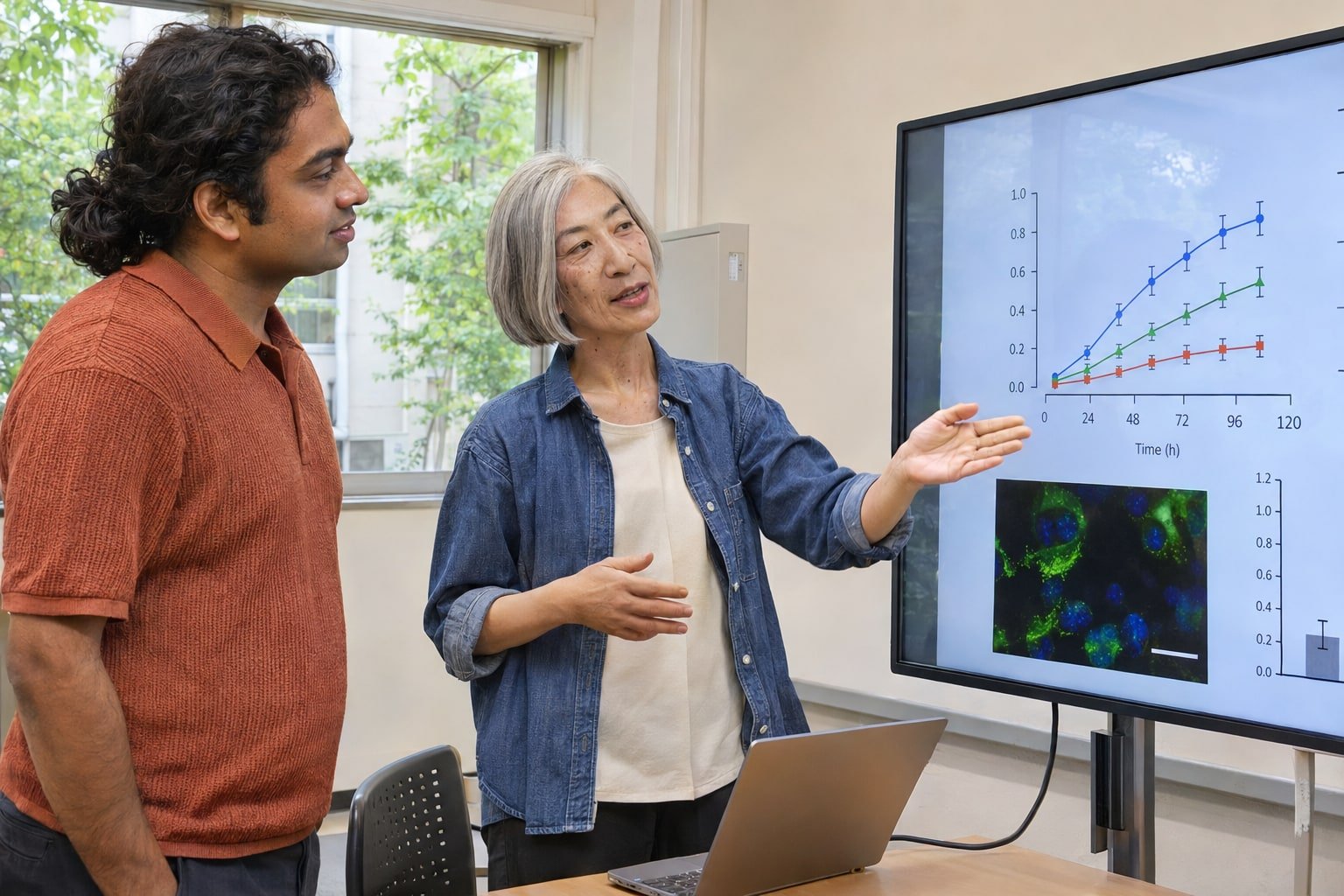
InterScience is a pharmaceutical communication agency founded in 1988, with head offices in Osaka and Tokyo and 170 employees as of April 2026. It offers medical writing, publication support, creative and digital production, and an in-house video studio. Its client list includes Takeda, Chugai, Astellas, and Pfizer. Pharmaceutical companies that need medical content and promotional production should consider its specialist services; its publication support also covers English papers.
Who runs science outreach for audiences in Japan?
Leave a Nest, Academic Brains, and Science Web connect research with audiences in Japan through education, events, and websites. Their services discussed here focus mainly on Japanese outreach, though Leave a Nest also runs international programs. Choose among them according to whether you need participation in science education, support for project outreach, or a research website.
Leave a Nest
Leave a Nest (リバネス), founded in Tokyo in 2002, calls its staff “science bridge communicators.” It connects researchers with schools, companies, and startups through hands-on classes, research grants, and Science Castle conferences for young researchers. Its Science Castle World 2026 announcement names 88 presenters from nine countries for the event scheduled for December 12–13, 2026. Organizations seeking education programs and direct contact with young researchers should consider this kind of outreach.
Academic Brains
Academic Brains organizes academic conferences and plans outreach for grant-funded research projects. It supports outreach around each project’s midterm and final evaluations and produces newsletters and interview articles. That makes it relevant to research teams whose communication work must follow a funded project’s schedule and reporting requirements.
Science Web
Science Web, based in Tsukuba, builds websites and registration systems for labs and grant-funded projects, including KAKENHI and Moonshot projects. It also handles search optimization for those sites. A lab or project team that needs a website and the systems behind its events should compare this service with its technical and maintenance requirements.
Which companies make research visual?
Science Graphics produces scientific illustrations, journal covers, and animations, while miseru design specializes in scientific illustration. Their work helps readers understand research visually and contributes to building a science brand. A commission should specify what the visual needs to explain and where readers will encounter it.
Science Graphics
Science Graphics, founded in Kyoto in 2004, has worked with more than 400 universities, research institutes, and academic societies. It has produced over 3,000 journal cover images, with work appearing in journals from publishers including ACS, RSC, and Wiley. Its services also include CG animation, augmented reality (AR), and virtual reality (VR). It’s a provider to consider when the assignment requires scientific visualization or animation.
miseru design
miseru design, founded in Tokyo in 2023, draws scientific illustrations for press releases, papers, and conference materials. Its focus suits teams commissioning an illustration to explain their findings or technology.
Which firms get science from Japan covered outside Japan?
Ellerton & Co. works with media across Asia through its Japan and regional teams, while the Science Media Centre of Japan connects researchers with journalists covering science news. They offer different routes into reporting: Ellerton provides commercial PR services, and the Science Media Centre supplies expert comment on scientific issues.
Ellerton & Co.
Our partner firm, Ellerton & Co., is based in Singapore with teams in Japan, the Philippines, Malaysia, Indonesia, Vietnam, Thailand, and India, plus Europe. Its science and research technology PR service helps research platforms, scientific software providers, and technical AI companies reach business and technology media. It fits companies seeking commercial visibility outside Japan. We compare this approach with doing PR yourself and using newswires in our guide to PR for AI search.
Science Media Centre of Japan
The Science Media Centre of Japan is a nonprofit that sends journalists expert comment when science makes the news. Its expert-comment work follows the news agenda; it offers a different route from hiring an agency to promote a company or research announcement. Researchers can register in its expert database so the center can contact them when journalists need comment in their field. Registration doesn’t guarantee coverage.
When do freelancers or an in-house team make more sense?
Freelancers can suit one-off articles and steady blog output, while in-house teams suit organizations with constant news and approval needs. The scope needs to be explicit: international media outreach and search strategy require time and expertise of their own, so confirm who will provide them before commissioning the writing.
Freelance science writers in Japan include PhD researchers and former journalists. Ask for published English samples in your field and check how the writer explains findings and their limitations. Agree who handles distribution and pitching, since a writing assignment alone doesn’t establish responsibility for either.
Kyoto University set up its international PR office in 2015 with one English press-release writer and one editor, while the University of Cambridge had six research communications writers in 2016. These figures describe staffing in 2015–2016. Your organization can also combine internal and outside support: your team supplies the facts and approvals, while an outside firm takes on writing, pitching, and search optimization.
How do these science communication providers compare?
Compare providers against the task you need done first, then check whether their language coverage and delivery scope match the assignment. Here’s a quick layout of the value these companies offer.
| Provider | Base | Strongest at | Main language |
|---|---|---|---|
| MacroLingo | Osaka | Content strategy, press releases, PR, AI search | English and Japanese |
| ThinkSCIENCE | Tokyo | Author training, publication writing | English and Japanese |
| InterScience | Osaka and Tokyo | Pharma communication, medical writing | Japanese; English publication support |
| Leave a Nest | Tokyo | Outreach, education, industry links | Japanese; English in international programs |
| Academic Brains | Japan | Outreach for grant-funded projects | Japanese |
| Science Web | Tsukuba | Project and lab websites | Japanese |
| Science Graphics | Kyoto | Journal covers, CG animation | Visual |
| miseru design | Tokyo | Scientific illustration | Visual |
| Ellerton & Co. | Singapore | Media relations across Asia | English and local languages |
Questions people ask about science communication in Japan
What’s the difference between science communication and scientific editing?
Scientific editing prepares a manuscript for a journal and its specialist reviewers. Science communication explains the finding to people outside that field, including journalists, buyers, funders, and policymakers, through releases, articles, and media work. A provider’s experience should match the audience you need to reach.
Can a Japanese university hire an outside company for English press releases?
Japanese universities can commission outside providers to write English press releases, then publish them on their own news pages or distribute them through newswires. University research administrators (URAs) and media offices can keep responsibility for the scientific checks and approvals while commissioning the writing. We provide that service; our work includes a life sciences release and one on public health. Our comparison of science press release sites covers where to send them.
Does science communication help a company sell?
Science communication supports sales when it reaches buyers and explains what they need to evaluate a technology. Science-to-business (S2B) marketing turns findings into articles and pages that procurement teams can find and assess. The content needs to connect the research with a buying decision, including the evidence and limitations that affect its use.
How can MacroLingo help with science communication in Japan?
MacroLingo fits organizations that need scientific and technical content for international readers, with content strategy, press releases, articles, and search optimization planned together. We also work with Ellerton & Co. on media outreach to help your research or technology earn coverage and become a source that AI search can cite.
A specialist in researcher training, pharmaceutical communication, Japanese outreach, or scientific illustration may be a better fit when that is the main assignment. We’re happy to discuss where our work fits your needs. We can help with a single English release or full year of content and PR; tell us what you’re working on and we’ll reply within one business day. You can also see more of our releases and articles on our success page.