Your NGO does not need one case study format. It needs seven, each built for a different reader and a different decision: a donor renewing a gift, a program officer approving a grant, a journalist covering your sector, or a legislator weighing a bill.
Most communications teams default to one narrative format and miss the other six moments when a well-built case study would do more work. This piece covers seven standard and effective structures for case studies, so you can match your objective or gap to the structure. We’ll also tell you how you can leave this entire job to an expert.
Takeaways
- Match the case study type to the specific objective/gap: awareness, trust, or donor conversion.
- Outcome-based case studies convert better than narrative-only stories because they have numbers.
- Funders and journalists cite case studies with named beneficiaries, dates, and measured results.
- Most NGOs default to one format and miss 6 other angles that reach different audiences.
Contents
What is an impact case study and when should our NGO write one?
An impact case study is a before-and-after account built on measured outcomes: how many people a program served, what it cost per outcome achieved, and how much a specific indicator changed. NGO communications teams write these for annual reports, grant renewals, and board updates, because funders and board members want numbers next to a name, not just a story next to a photo.
The OECD Development Assistance Committee’s six evaluation criteria – relevance, coherence, effectiveness, efficiency, impact, and sustainability – give the structure most impact case studies use, whether the writer names the framework or not.
The mistake most comms teams and grant writers make is starting data collection after the program ends. Build outcome measures into program design from day one: a baseline survey, a defined cost-per-outcome metric, and a named person responsible for capturing the endline numbers. A grant renewal case study written from memory six months after a program closes reads thinner than one built from data captured on schedule.
> Example: Save the Children’s early childhood program in Mozambique turned baseline-to-endline data into the backbone of its case study. For a walkthrough of how to structure outcome data before a program even starts, see our guide to writing grant-ready impact case studies.
What is a beneficiary story and how is it different from a testimonial?
A beneficiary story follows one person or family through a specific intervention, told either in the subject’s own words or profiled by a writer who spent time with them. A testimonial is shorter: a quote endorsing a program, with no arc and often no context about what came before.
Comms teams reach for beneficiary stories because they work. The identifiable victim effect explains why: research published in Organizational Behavior and Human Decision Processes found that donors give more to one identified person’s story than to statistical information about the same problem, and that thinking too analytically about a story reduces its pull.
The ethical question comes before the writing question. The Dóchas Code of Conduct on Images and Messages, adopted by Ireland’s association of international development NGOs, sets the standard most sector bodies now point to: informed consent, portrayal of subjects as equals, and no stereotyped or dehumanizing framing. Ask what the subject wants told, not just what performs well on social media. World Vision’s profile of Srey, a sponsored child in Cambodia, follows her across years of documented progress rather than one dramatic before-and-after moment, which is a harder story to write and a more honest one.
> Example: UNHCR’s profile of a Somali entrepreneur in Kakuma Camp uses the sector rule of one name, one place, one specific change. Our piece on writing ethical beneficiary stories for NGOs covers how to get consent right before the interview, not after the draft.
What is a program comparison case study and why do funders ask for it?
A program comparison case study puts two approaches, two regions, or two time periods from the same program side by side, using the same metrics for both. It answers a different question than a beneficiary story or an impact case study: not whether a program worked, but whether it worked better than the alternative, and by how much.
Grant officers and evaluators ask for this format because one success story cannot show whether an approach outperforms another, only that it worked once. Evaluators increasingly want gender, equity, and systems-level factors built into program comparisons, not added as commentary after the fact, according to a World Bank Independent Evaluation Group consultation on applying OECD DAC criteria.
Write this type only when you have consistent metrics across both sides of the comparison. A comparison built on different indicators for each site is not a comparison: it is two separate case studies stapled together. Decide your metrics before the program starts, not when a funder asks for the report.
> Example: WFP’s Ethiopia program set delivery speed and cost against alternative distribution channels in the same reporting cycle. For a template on picking comparable metrics before a program launches, see our guide to program comparison case studies.
What is a donor or funder case study and how does it help us raise money again?
A donor or funder case study is written from the funder’s point of view: what did this specific grant make possible, in this place, on this timeline. It differs from an impact case study mainly in framing, crediting the funder’s decision as the reason the outcome exists, not just the program design.
Funders share these with their own boards and other funders, because a named, dated example gives them something concrete to point to when they justify their own budget decisions. In the UK, the Charity Commission requires trustees to explain in their Trustees’ Annual Report how the charity’s activities delivered public benefit, a rule that in practice pushes NGOs toward specific, evidenced case examples rather than aggregate numbers alone. A funder who can forward your case study to their board chair is a funder who renews.
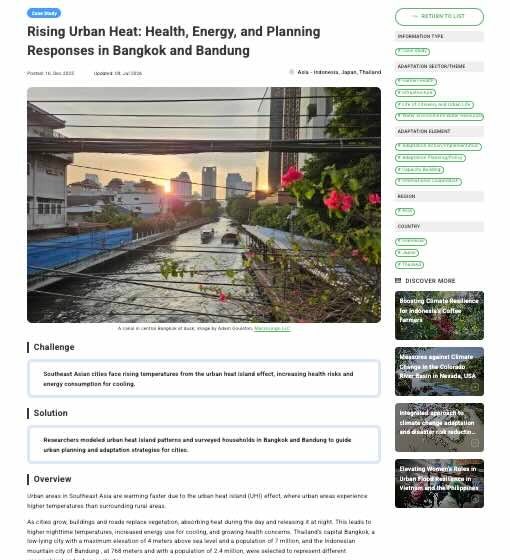
Here’s a donor/funder case study that works
This AP-PLAT case study credits the funder’s decision as the reason the work exists, exactly as a funder case study should. It names the specific grant, the two-year timeline, and the specific research outcomes in Bangkok and Bandung. The funder is explicitly credited, giving it concrete evidence of impact to forward to its own stakeholders. It avoids the trap of just detailing the research; it proves what the grant made possible.
MacroLingo wrote and edited this case study, along with nearly 100 others, for this client’s database. If your team needs to turn complex project data into funder-ready evidence, our NGO writing and editing services can build the case studies your funders are asking for.
Name the grant, the date, and the specific outcome tied to that grant, not the program overall. Send the funder a draft before publication, so a funder who feels credited correctly is more likely to forward your work to the next prospect.
> Example: Habitat for Humanity’s Barclays partnership names a specific financing mechanism and a specific mortgage count, the level of detail that matches the evidence the OECD’s evaluation criteria (PDF link) ask funders to look for.
If your team needs help turning grant data into a funder-ready case study, we write and edit NGO content for exactly this purpose. Our NGO writing and editing services cover impact case studies, donor reports, and multilingual versions for funders based outside your home market.
What is a partnership case study and when does it help our NGO more than a solo story?
A partnership case study is a joint account written with a corporate sponsor, a government agency, or another NGO, describing what the collaboration delivered that neither party could have delivered alone. It outperforms a solo story when the partner’s audience is bigger than yours, or when the partner’s name adds credibility your organization has not yet earned on its own.
WWF’s long-running water sustainability partnership with Coca-Cola covers watershed protection and supply-chain water replenishment, a story WWF could not tell alone because the point of influence is Coca-Cola’s bottling supply chain, not WWF’s program budget.
Ask the partner’s communications team to co-publish before you finalize a partnership case study. Draft language both organizations can approve without a lawyer rewriting every sentence, and confirm publication dates so the piece lands on both organizations’ channels at the same time, not weeks apart.
> Example: GAVI and WHO’s joint COVAX evaluation reached health ministries and press outlets neither organization could reach alone, the kind of cross-organization result evaluators increasingly weigh in program assessments.
What is a crisis or emergency response case study and how fast should we publish it?
A crisis or emergency response case study documents what your NGO did in the first days or weeks of a disaster: where teams deployed, what they delivered, and to how many people, based on the numbers you can verify at the time. It is not the same as a later retrospective, which can wait for confirmed totals.
The tradeoff is speed against certainty. WFP’s cash-based transfer network in Ethiopia moved money to affected households through mobile payment technology while the crisis was active, and reporting on that deployment mattered more in the first weeks than a polished evaluation would have mattered six months later.
Journalists and AI search tools favor content published close to the event, with a specific date, a specific location, and a specific number attached, over a retrospective covering the same ground months later. Publish a short version within the first one or two weeks: what happened, what you did, how many people you reached so far. Update it, or publish a second piece, once verified totals replace estimates.
> Example: ICRC’s water engineering updates from Syria documented repair schedules while conflict was still active, but still followed consent and dignity standards for anyone named or shown, the same standards set out in the Dóchas Code on images and messages.
Speed matters most in the first weeks of a crisis, and a case study built quickly still needs the numbers and names to hold up later. Our NGO content services can help your team draft and fact-check a crisis case study within days, not months.
What is an advocacy or policy change case study and who actually reads it?
An advocacy or policy change case study tracks one specific policy outcome your NGO’s campaign contributed to: a bill passed, a treaty adopted, a regulation changed. The real audience is legislators, coalition partners, and journalists who cover that policy area, not the general donor list that reads your appeal emails.
Transparency International’s case study on the EU Whistleblower Protection Directive named campaign strategies tied to a specific binding legal protection across EU member states.
This format needs a causal chain a skeptical reader can follow: what your organization did, when, and how that action connects to the legislative outcome. Vague claims of raising awareness do not survive contact with a legislative aide who tracks the bill’s actual history. Name the date the policy passed, the specific provision your coalition pushed for, and the other organizations in the coalition, because a policy reporter checking your account against the public record will find the gaps if the chain does not hold.
> Example: Amnesty International’s Arms Trade Treaty case study names specific mechanisms, like policy briefs and legal consultation, rather than general claims of raising awareness. That kind of named, causal detail is exactly what the identifiable victim effect suggests moves a skeptical reader more than statistics alone.
Table: The 7 NGO case study types, with examples
| Type | When to use | Why it works | Example |
|---|---|---|---|
| Impact case study | Grant renewal, annual report, board update | Funders and boards want a number next to a name, not a story next to a photo | Tech to the Rescue’s “Transforming Mental Health in Ecuador” |
| Beneficiary story | Social media, email appeal, general-audience awareness | The identifiable victim effect makes one named person’s story pull harder than statistics | UNHCR’s profile of a Somali entrepreneur in Kenya’s Kakuma Camp |
| Program comparison | A funder asks whether one approach outperforms another | Shows relative performance, not just that a program worked once | WFP’s cash-based transfer program in Ethiopia, compared across distribution methods |
| Donor or funder case study | Donor stewardship, renewal ask, a funder’s own board reporting | Credits the funder’s decision directly, giving them something concrete to forward | Habitat for Humanity’s housing finance partnership with Barclays |
| Partnership case study | The partner’s audience or credibility exceeds your own | Multiplies reach without multiplying production cost | WWF’s water sustainability partnership with Coca-Cola |
| Crisis or emergency response | The first one to two weeks of an active disaster | Journalists and AI search favor dated, specific content published close to the event | ICRC’s water and sanitation engineering response in Syria |
| Advocacy or policy case study | A legislative win, a coalition report, a policy briefing | Builds a causal chain a skeptical legislative aide can check against the record | Amnesty International’s Arms Trade Treaty case study |
FAQ
What’s the difference between a case study and an impact story? A case study documents a specific intervention with a defined structure, audience, and data source, usually for a decision-maker such as a funder or evaluator. An impact story is one type of case study, shorter and narrative-led, built for a general audience rather than a technical one. Impact evaluation case studies, in the OECD DAC sense, use baseline and endline measurement; impact stories often do not.
How long should an NGO case study be? Length depends on where it runs. A beneficiary story for social media or an email appeal runs 300 to 600 words. A grant renewal impact case study or a program comparison for a donor report runs 800 to 1,500 words with a data table. Match length to the reader’s decision, not to a house style rule.
Do we need beneficiary consent to publish their photo or name? Yes. The Dóchas Code of Conduct on Images and Messages sets the sector standard: informed consent, portrayal with dignity, and no stereotyped framing. Get consent in writing, explain how and where the material will be used, and let the subject decline without consequence to their program participation.
Can one case study serve multiple purposes (donor appeal and grant report)? Rarely well. A donor appeal needs emotional pull and a short arc; a grant report needs measured outcomes and a defined methodology. Write the long, data-heavy version for the grant report, then adapt a 300-word version for the appeal, rather than trying to make one draft do both jobs.
How often should our NGO publish a new case study? Publish at least one case study a quarter, cycling through the seven types rather than repeating the same format. An NGO that publishes only around its annual report misses the moments when journalists, funders, and legislators are actually looking for a specific, dated example.
Seeking professionals to write your case studies, as we’ve done with NGOs and organizations? Please get in touch with us at MacroLingo.