
Science and technology companies tend to underinvest in digital marketing relative to the quality of their work. The buyers who would purchase, the investors who would fund, and the partners who would collaborate often find a competitor first – because that competitor showed up in a search result, a LinkedIn feed, or a media report.
Digital marketing for science and technology covers SEO and AI search, content marketing, LinkedIn, earned media, email, paid advertising, and video. Each channel behaves differently here than in consumer or SaaS marketing – sales cycles are longer, buyers research extensively before engaging, and every claim must hold up to scrutiny. This article covers each channel, what to do within it, and what a realistic budget allocation looks like at two different spending levels.
Takeaways
- Science and technology buyers research extensively before engaging – every channel needs to show that your company knows what it’s doing, not just that it exists
- LinkedIn is the primary B2B platform for most science and technology companies; spreading resources across every platform rarely produces better results than concentrating on one or two
- Earned media and SEO feed each other – coverage in credible publications builds the links and citation record that improves organic search rankings
- Long sales cycles make email one of the highest-return channels available, because it keeps you in front of prospects through months of evaluation
- A limited budget goes furthest when concentrated on the channels where your specific buyers actually spend time
Table: Key digital marketing tactics for science and technology companies
| Tactic | What it does |
|---|---|
| SEO and AI search | Positions website and content to appear when buyers research solutions in your category, including in AI-generated answers |
| Content marketing | Blog posts, white papers, and case studies that build credibility and organic traffic over time |
| Primary B2B channel for building executive profiles, posting company news, and getting in front of the people who make purchasing decisions | |
| Earned media and PR | Coverage in credible publications that builds the independent editorial record search engines and AI systems trust |
| Email marketing | Keeps your company in front of prospects through months of evaluation, using content tailored to where each person is in the buying process |
| Paid advertising | Accelerates reach on LinkedIn and Google for specific campaigns; produces no results after the budget stops |
| Video | Makes complex products, processes, and technical expertise accessible to non-specialist audiences |
SEO and AI search
Technical SEO is the foundation. Pages load fast, carry proper metadata, and are structured so search engines can index them accurately. Beyond that, the highest-return activity is building topic clusters: a pillar page on each core subject your company addresses, supported by related articles linking back to it. That structure tells search engines your site covers a subject in depth and gives buyers several ways to find you depending on how they phrase their search.
AI search draws on the same signals as traditional SEO, plus the earned media record that establishes a brand’s credibility across independent sources. When ChatGPT, Perplexity, or Google’s AI Overviews answer a question about your category, the brands they cite are those with both solid on-site content and consistent coverage in credible publications. MacroLingo’s analysis of how PR and earned media drive AI search visibility covers the mechanics in detail, and MacroLingo’s SEO and AI search optimization services include multilingual optimization for companies operating across Asian markets.
For science and technology companies operating across Japan, Southeast Asia, and other non-English markets, a website serving only English-language search misses buyers researching in Japanese, Chinese, Bahasa, or Korean.
What you can do
- Run a technical audit covering page speed, Core Web Vitals, broken links, and metadata – free tools like Google Search Console and PageSpeed Insights cover the basics
- Map 3-5 topic clusters around your core product or service categories and build a pillar page for each
- Publish supporting articles monthly that link back to each pillar page, covering the questions your buyers ask before purchasing
- Add structured data markup (schema) to product and technology pages so search engines can surface them in richer formats
- Set up Google Search Console if you haven’t already and track which queries are bringing people to your site
Content marketing
Content marketing for science and technology companies builds the proof record that buyers consult before making contact. Blog posts, white papers, technical case studies, and application notes all show buyers that your organization understands the problems it claims to solve.
The challenge is that most science and technology teams write for peers. The procurement managers, investors, and journalists who will ultimately act on that content are not peers. Writing technically credible material that non-specialists can read and act on is a specific skill. MacroLingo’s piece on writing science for everyday readers covers that challenge directly.
Consistency matters more than volume. A steady monthly cadence of one or two well-researched pieces builds more organic authority than occasional bursts followed by long silences.

Medical device, pharmaceutical, and diagnostics companies face additional constraints. Claims require substantiation and regulatory clearance, and direct-to-consumer advertising for prescription-only products operates under strict rules that vary by market. Those restrictions don’t extend to content marketing, editorial coverage, or earned media.
A medical device company can publish clinically grounded articles that build credibility with surgeons and procurement teams without making product claims that require clearance. It can maintain a LinkedIn presence, earn coverage in medical trade publications, and appear when buyers search for answers to the clinical problems its products address. Companies that confine themselves to trade shows and distributor relationships because they believe regulation prevents digital marketing are applying the restriction too broadly.
What you can do
- Publish at least one substantive post per month – each piece should answer a specific question your buyers ask before making contact
- Convert your last three case studies or application notes into proper web content with headlines, buyer-facing language, and clear outcomes
- Build a simple quarterly content calendar that maps topics to the channels where each piece will appear
- Commission one white paper or technical guide per quarter on a subject your category actively searches for
- Write for the procurement manager and the laboratory director at the same time – technically credible, but readable without a PhD
LinkedIn and social media
LinkedIn is where procurement teams research vendors, investors track sectors, and journalists find spokespeople. A company with an inactive LinkedIn presence and executives who don’t post is handing that visibility to competitors who do.
The most effective LinkedIn programs for science and technology companies combine three things: company page posts covering milestones, partnerships, and product news; posts from named executives on topics relevant to their sector; and direct replies to relevant conversations. Named executives who post regularly build a following over time. Journalists already know who they are when a story breaks and are more likely to call them for a quote. AI systems are more likely to cite them.

YouTube is worth investing in if video content is already part of the strategy. Other platforms are worth maintaining only if your buyers actually use them.
What you can do
- Have your CEO or CTO post at least twice a week from their personal profile – company page posts alone don’t build the same reach or trust
- Post a company update for every milestone: a hire, a certification, a product development, a client win, a regulatory approval
- Reply directly to posts by journalists, analysts, and potential clients in your sector – engagement is more visible than most people realize
- Run a follower campaign targeting the job titles and company types in your buyer profile
- Check LinkedIn Analytics monthly and drop post formats that don’t drive profile visits or follower growth
Earned media and PR
Earned media is coverage in publications your company doesn’t own or pay for. When a technology publication profiles your work, when a trade outlet covers a financing round, or when an analyst report names you in a category, that coverage builds the independent editorial record that both search engines and AI systems draw on.
Ellerton & Co.’s insight into what it actually takes to earn coverage in Malaysia translates directly to the rest of Southeast Asia. Earned media requires knowing which journalists cover your category, building relationships over time, and pitching angles that serve their readers.
A press release sent without a prior relationship rarely gets picked up. MacroLingo’s PR and media services for science and technology run through a partnership with Ellerton & Co. across Singapore, Malaysia, Japan, India, and European markets.
What you can do
- Write a press release for every material milestone – financing rounds, partnerships, regulatory approvals, product launches, and major client wins all qualify
- Build a media list of 10–15 journalists who actively cover your category and update it twice a year
- Put a press page on your website with releases, executive bios, product images, and a media contact email
- Make a named executive available for journalist briefings in the two weeks before any major announcement
- Enter relevant sector awards and rankings – shortlists and wins generate free coverage with no pitch required
Email marketing
Email produces some of the best returns for B2B science and technology marketing because it operates well over long sales cycles. A prospect who downloaded a white paper six months ago but has since gone quiet can be reactivated through a sequence that delivers relevant content at appropriate intervals.
Segmentation is where most of the performance gain comes from. A procurement officer, a laboratory manager, and a fund manager evaluating an investment need different content, different levels of technical detail, and different calls to action – sending one email to all three produces poor results for each. HubSpot’s marketing research finds that 78% of marketers consider subscriber segmentation the most effective strategy for email campaigns.
What you can do
- Set up a welcome sequence for anyone who downloads a white paper or signs up – three emails over two weeks covering your core value proposition is enough to start
- Segment your list by role from the beginning: buyers, investors, and partners each get content written for what they care about
- Send a monthly email linking to your latest content, news coverage, and any upcoming events or webinars
- Use email to extend the life of press coverage – link to media articles in your newsletter and tell subscribers what the coverage means
- Track open and click rates by segment each month and cut content types that consistently underperform
Paid advertising
Paid channels accelerate reach but stop the moment the budget stops. For science and technology companies, paid works best as a targeted complement to organic activity, not a substitute for it.
LinkedIn Ads produce the best results for most B2B science and technology companies because of the job title and company type targeting options. A campaign targeting procurement or R&D buyers at specific company types, offering a white paper or webinar, is more precise than broad display advertising. Google Ads work well for high-intent search terms where someone is actively looking for a specific solution.
What you can do
- Start with LinkedIn Ads targeting specific job titles and company sizes rather than broad interest categories
- Promote a white paper or webinar rather than a product page – give people a reason to click before asking them to buy
- Retarget website visitors with LinkedIn or Google display ads offering deeper content based on which pages they visited
- Set a monthly budget cap and track cost per lead from the first campaign before putting more money in
- Run Google Ads against 5–10 high-intent search terms specific to your product or technology category
Video
Video removes the abstraction from complex science and technology products. A two-minute animated explainer, a brief executive interview on a topical question, or a documentary-style site visit shows buyers things that written content can describe but rarely makes concrete enough to act on.
For most science and technology companies the highest-return video investment is a small library of focused explainers and short executive interviews, plus event footage that extends the reach of in-person conference participation.
What you can do
- Film a 2–3 minute product explainer showing the product in use, not just describing it – a surgeon using your company’s device is more compelling than a slide about its specifications
- Record a short executive interview after each major announcement, partnership, or product milestone
- Repurpose conference presentations as short clips for LinkedIn and YouTube
- Film testimonials from distributors or end users who can speak to specific outcomes in plain language
- Add captions to every video – a significant share of views happen without audio, particularly on LinkedIn
What it looks like in practice
Blueleaf Energy (Singapore)
Blueleaf Energy is a Singapore-headquartered independent power producer (IPP) with a pipeline of over 4.5 GW of generation capacity and nearly 3 GWh of storage assets across Southeast Asia, India, Taiwan, and Japan. Owned by a Macquarie Asset Management managed fund, it operates across some of the most fragmented and relationship-driven procurement markets in Asia.
Blueleaf’s website runs in English, Japanese, and Traditional Chinese, with separate localized versions rather than translated copies. That multilingual structure serves buyers researching in their own language and feeds SEO across three separate regional markets simultaneously.
On LinkedIn, the company runs a consistent content program mixing partnership announcements with editorial series. The “Women in Power” series gives named employees from different offices a platform to share perspective and experience, producing content that travels further than standard corporate announcements. CEO Raghuram Natarajan is named and quoted in press releases, giving media a direct contact and building executive profile across markets.
Earned media is built around structured announcements. In October 2025, Blueleaf’s $75 million financing facility from British International Investment to accelerate 2 GW of clean energy capacity in India was announced through a press release with named signatories and covered in Business Standard, pv magazine India, Renewable Watch, and others. The signing ceremony was held at the British High Commissioner’s residence in Singapore – a PR event that extended the story’s reach and added diplomatic framing to the announcement.
A mid-sized team with a content plan, a named executive who posts and comments, consistent earned media work around milestones, and a website built to serve multiple language markets can run a program that competes with much larger organizations.
Yasui Co., Ltd. (Japan)
One of our clients in Japan offers a clear illustration of this pattern.
In years of working with Japanese manufacturers, I’ve come across companies with world-class technology, ISO certifications, and national television coverage whose websites hadn’t been updated in years and whose English-language content barely reached the international buyers actively searching for their products.
Japan has one of the world’s highest concentrations of deep manufacturing and engineering capability, and a large portion of it remains invisible online outside of Japan.
MacroLingo works with Yasui Co., Ltd., a century-old manufacturer based in Miyazaki, Japan, whose experience shows what happens when a company with strong technology finally backs it with a proper digital presence.
Yasui makes the koplight™ – a cordless surgical light retractor that delivers direct, shadowless LED illumination inside the surgical field during breast, plastic, and other surgeries. The product is ISO 9001 and ISO 13485 certified, made in Japan, and has been featured on NHK World. It sells to surgeons and distributors across the US, Europe, and other international markets. Before MacroLingo’s involvement, the digital presence wasn’t reaching the international buyers who needed to find it, despite the product’s quality and the media coverage it had earned.
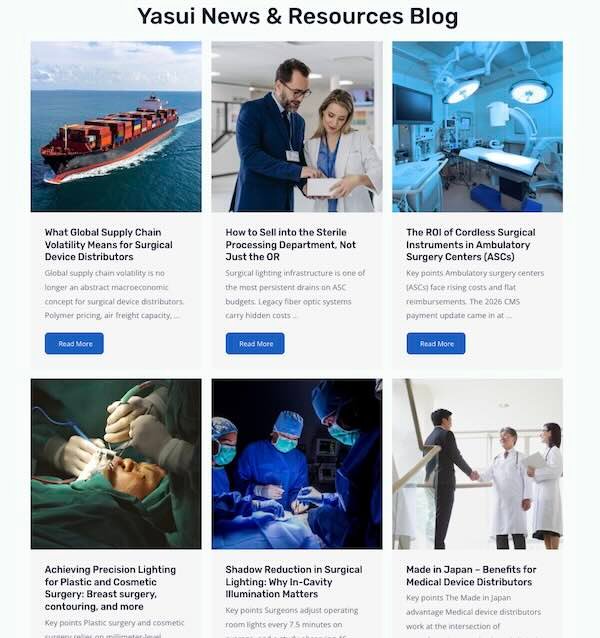
After a full website redesign and localization to replace the directly translated former site, MacroLingo built an English-language content blog covering clinical topics relevant to the surgeons and procurement teams Yasui needed to reach, restructured the website for international markets, and produced fully localized materials for Yasui’s target regions. Global inbound leads from distributors and clinical professionals increased considerably. Yasui had the technology, the certifications, and the television coverage. What it didn’t have was a website and content that international buyers could find.
Now it does, and digital marketing on a modest budget is working. An even bigger budget would go even further.
Starting with a limited budget
Most science and technology companies aren’t working with unlimited marketing resources. The question isn’t whether to invest in digital marketing but where a constrained budget goes furthest. The answer depends on where your specific buyers spend time, but the allocations below represent a workable starting point for the channels covered in this article. The $25,000 figure supports a full multi-channel program with meaningful PR coverage. The $5,000 figure covers the foundations – enough to build an organic presence and establish a media relationship in one key market.
Table: What you can do now even on a limited budget
| Channel | At $25,000/month | At $5,000/month |
|---|---|---|
| SEO and content | $7,000 – 2 blog posts + 1 white paper per month, keyword tracking | $1,500 – 1 post per month, SEO audit |
| Earned media and PR retainer | $8,000 – media relations across 2-3 markets, 2 press releases per month | $2,000 – 1 market, milestone releases only |
| LinkedIn Ads | $5,000 – job title and company type targeting, white paper offer | $1,000 – single retargeting campaign |
| Email marketing | $2,000 – segmented sequences, automation, platform | $500 – basic platform, one nurture sequence |
| Video (amortized quarterly) | $2,000 – 1 explainer or executive interview per quarter | $500 – screen-recorded product walkthrough |
| Analytics and tools | $1,000 – SEO platform, campaign dashboard | $500 – Google Analytics, free-tier SEO tools |
Measurement
Most digital marketing produces data that looks useful but doesn’t connect to revenue. The three numbers that matter for science and technology companies are qualified leads entering the pipeline, cost per lead by channel, and whether sales cycles are getting shorter. Organic traffic and LinkedIn follower counts are useful directionally but tell a CFO nothing about what the marketing program is worth.
A CRM that records lead source, UTM tags on all campaign links, and a monthly review that maps channel spend against pipeline contribution will cover most of what a science and technology company needs to make informed decisions.
For companies running PR alongside other channels, branded search volume in Google Search Console is a useful proxy for earned media impact. When the PR program is working, more people search directly for your company name, and that trend is trackable without additional tooling.
Working with MacroLingo
MacroLingo works with science and technology companies across Japan and Asia-Pacific on the digital marketing programs covered in this article. Content services cover SEO-optimized blog posts, technical white papers, case studies, and scientific press releases – written to make sense to technical buyers and non-technical buyers at the same time. For companies whose buyers research in Japanese, Chinese, Korean, or Bahasa Indonesia, MacroLingo develops bilingual and multilingual content built to perform in those markets rather than translated from English as an afterthought.
Working with Yasui is representative of how MacroLingo approaches Japanese clients: a website built for international buyers, a content program written for the clinical and commercial audiences the product needs to reach, and localized materials that remove the language barrier for distributors and procurement teams in each target market. Companies with strong products and weak digital presence outside Japan see real changes in how often and from where inbound inquiries arrive.
On the search side, MacroLingo’s SEO and AI search optimization work covers both traditional organic search and the AI systems that now determine which brands appear as cited sources when buyers research solutions in a given category. Writing science and technology content that non-specialists can read and act on drives both – covered in detail at writing science for everyday readers.
For earned media and PR, MacroLingo works in partnership with Ellerton & Co., a specialist PR agency with active media networks across Singapore, Malaysia, Vietnam, Indonesia, the Philippines, Thailand, India, Japan, and Europe. MacroLingo handles content, SEO, and science writing; Ellerton handles media relations and press coverage. They run as one program. More detail is at MacroLingo’s PR and media services for science and technology.
Get in touch to discuss where your digital marketing program should start.