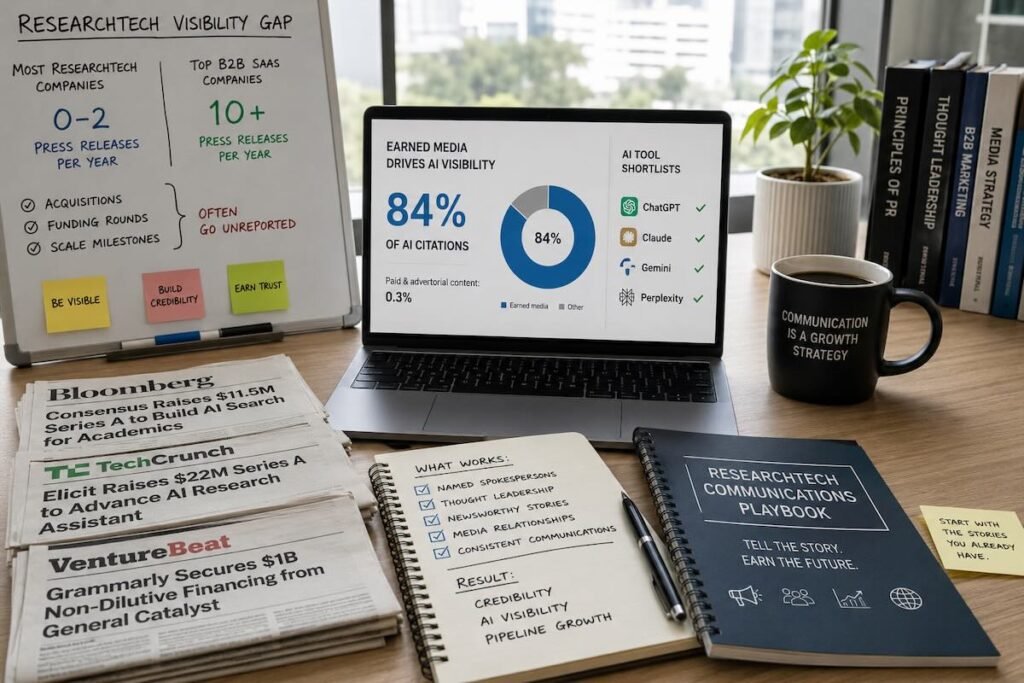
Academic technology (scholarly technology, ResearchTech, etc.) companies have built tools used by millions of researchers, raised tens of millions of dollars, and completed acquisitions worth covering – while most of the technology press has never heard of them. The traction is there. The communications to match it are not.
Let’s take a quick look into the size of the visibility gap, the business events that went uncovered as a result, what comparable B2B software companies do differently, and why AI-driven discovery made the gap urgent. The practices that would close it are not complicated. They’re simply not being applied.
Takeaways
- Most scholarly publishing technology companies publish 0–2 press releases per year; comparable B2B SaaS companies publish 10 or more
- Acquisitions, funding rounds, and scale milestones that would generate business press in any other sector routinely pass unannounced in ResearchTech
- Earned media accounts for 84% of AI citations – companies absent from the press are absent from AI-generated tool shortlists
- B2B decision-makers increasingly self-direct their buying decisions; reaching them requires content and editorial coverage, not sales outreach
- The practices needed to build profile in ResearchTech are the same ones B2B software companies adopted years ago
The visibility gap in ResearchTech
My audit of more than 100 scholarly publishing technology platforms, which I mentioned on the Ellerton & Co. blog, found that six of seven workflow platforms generated zero Tier-1 business press coverage over two years – including across two material acquisitions. Top B2B SaaS companies publish 10 or more press releases per year. Most AI-native research tools publish 0–2.
The structural reasons are understandable. Many ResearchTech founders come from academic backgrounds where peer-reviewed publication is the measure of credibility and public promotion is treated with suspicion. Their users are trained the same way. Companies selling accuracy-dependent tools worry that aggressive PR associates them with an industry culture their users distrust.
Those concerns make sense within an academic frame. Outside it, they become a problem – because the buyers of ResearchTech tools make purchasing decisions the same way buyers of any other B2B software do, researching independently, reading what they can find, and shortlisting based on visible credibility. A company with no editorial record is invisible to that process whether its tools are excellent or not.
The business events that went uncovered
The practical consequences show up in what wasn’t reported.
In September 2023, the American Chemical Society acquired ChronosHub, an open-access management platform – a clean acquisition story between a major society publisher and a purpose-built tool. In January 2025, Morressier, a conference and preprint platform that had raised over $40 million, was acquired by Molecular Connections. In May 2025, Litmaps acquired ResearchRabbit; the combined service now reaches over two million researchers at Harvard, Stanford, Imperial College London, and Cambridge. Each transaction was a legitimate business story. Each was covered only in scholarly publishing trade press.
The contrast with the few companies that did get Tier-1 coverage is direct. When Consensus raised its $11.5 million Series A led by Union Square Ventures, the CEO gave Bloomberg an exclusive. When Elicit raised a $22 million Series A, TechCrunch covered it. Both companies now appear consistently in AI-generated answers when someone asks which AI tool to use for literature review. The connection between those two facts is not accidental.
There is also a brand risk in the silence. Kudos, a ResearchTech platform that helps researchers amplify their published work, is being outranked in AI-generated answers by an unrelated US fintech also named Kudos that invested early in mainstream PR. When the academic platform doesn’t appear in responses to its own name, the problem is not the product.
What B2B software companies do instead
Grammarly is an academic-adjacent writing tool that used sustained marketing, PR, and brand investment alongside a strong product to reach 40 million daily active users and secure a $1 billion non-dilutive financing from General Catalyst. Whether every ResearchTech company can follow that exact path is a fair question. The communications approach is worth studying regardless.
Mainstream B2B software companies treat communications as ongoing infrastructure rather than a campaign to activate when there is news. They designate and media-train named spokespeople, publish thought leadership under their own names, and treat every funding round, acquisition, and scale milestone as a media event requiring a plan. For these companies, communications runs continuously – not activated for announcements, but embedded in how the business presents itself at every stage.
The data behind this approach in B2B is consistent. The Edelman-LinkedIn B2B Thought Leadership Impact research found that 95% of B2B decision-makers and C-suite executives say strong thought leadership makes them more receptive to outreach from a company. That finding holds across industries. Library directors, research VPs, and journal editors are B2B buyers. There is no reason to believe they respond differently.
Why AI search made earned media important for ALL companies
For years, the cost of weak PR in ResearchTech was primarily lost visibility with journalists and trade publications; the AI wave changed that calculation entirely.
Muck Rack’s “What Is AI Reading?” research (May 2026, analyzing over 25 million links cited by ChatGPT, Claude, and Gemini) found that earned media accounts for 84% of all AI citations. Paid and advertorial content accounts for 0.3%. Library procurement teams, research administrators, and journal editors are increasingly asking AI assistants which tools to evaluate – and those systems draw on editorial coverage to construct their answers. A company absent from the press is absent from those answers.
Gartner research from late 2025 found that 67% of B2B buyers now prefer a purchasing process with no sales representative involvement at all. These buyers are self-directing through search, content, and AI. Companies that haven’t built an editorial record have no presence in that process regardless of how strong their product is.
The tools that built early AI visibility did so largely by accident – by releasing verifiable findings tied to a news peg, or by landing a funding announcement in a publication that LLMs cite heavily. A deliberate communications program would not leave that to chance.
Scholarly tech needs to start acting like B2B tech/software
None of this requires a large team or an immediate overhaul of how the business operates.
Start with the stories that already exist. Adoption milestones, institutional partnerships, validation studies, and product developments are publishable in the right hands. Most ResearchTech companies have several of these sitting undocumented. Write them up.
Designate a named spokesperson – the founder or a technical lead – and make them available to journalists covering AI, research, and publishing. Journalists covering the sector need people they can call; most ResearchTech companies make that harder than it needs to be. Stand up a press page with releases, executive bios, and a direct media contact.
Treat the next funding round or acquisition as a media event from the moment it closes. That means a news peg, a pitch, and a named journalist at a relevant outlet who is offered the story before it goes wide. Consensus and Elicit both used this approach. The results are visible in how both companies now appear when someone asks an AI assistant which literature review tool to use.
The scholars and engineers building ResearchTech tools have spent careers generating and communicating knowledge. Communicating about the tools is a different discipline, but not an unreachable one.
Working with MacroLingo and Ellerton & Co.
MacroLingo’s PR and media services for science and technology run through a partnership with Ellerton & Co., a specialist PR agency with active media networks across Singapore, Malaysia, Japan, India, Europe, and beyond. Get in touch to discuss what a consistent communications program looks like for your ResearchTech company.